
Why Students Should Verify UGC and AICTE Approval Before Admission
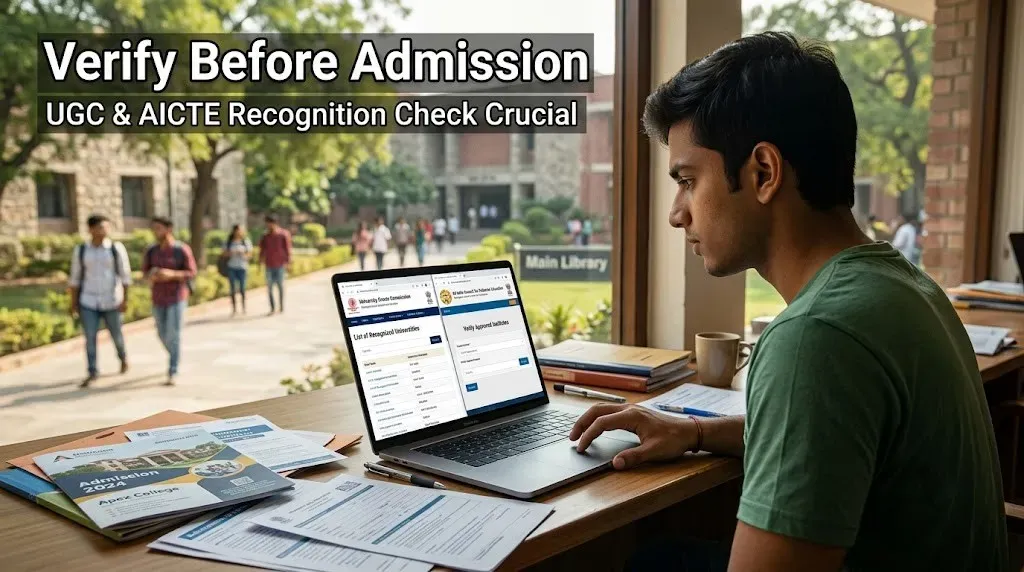
Why Students Should Verify UGC and AICTE Approval Before Admission
Choosing a college often begins with placement records, campus facilities, or tuition fees. Those factors matter, but they should never come before one simple check. Is the institution and its course approved by the appropriate regulatory authority? Many students realize the importance of this only after graduation, when applying for higher studies, government jobs, or professional licenses.
Spending a few minutes verifying approvals before paying the admission fee can prevent years of academic and financial problems.
UGC and AICTE are not the same
A common misunderstanding is that UGC approval and AICTE approval mean the same thing. They serve different purposes.
| Authority | Main Role | Covers |
|---|---|---|
| UGC | Recognizes universities and regulates higher education | Universities and degree granting institutions |
| AICTE | Regulates technical and professional education | Engineering, management, pharmacy, architecture and other technical programs where applicable |
Why approval affects your future
A recognized institution helps ensure that your degree is accepted for higher education, competitive examinations, and many recruitment processes. While eligibility depends on the specific employer or institution, recognition is often one of the first requirements checked during document verification.
Ignoring this step because a college advertises impressive infrastructure or placement claims can become an expensive mistake.
How to verify a college before admission
| Step | What to Check |
|---|---|
| 1 | Confirm the university appears on the official UGC recognized university list. |
| 2 | Check whether the specific technical program requires AICTE approval and verify its status. |
| 3 | Verify the course name and campus location carefully. |
| 4 | Review accreditation details such as NAAC or NBA if applicable. |
| 5 | Cross check the information on official regulatory websites instead of relying only on advertisements. |
The mistake many students make
Some applicants assume that if a university is recognized, every course offered by every affiliated campus automatically has every required approval. That is not always the case. Recognition, affiliation, accreditation, and program approvals are separate concepts. Students should verify the exact course they plan to join rather than relying on general statements made in promotional material.
Recognition, approval and accreditation are different
| Term | Meaning |
|---|---|
| Recognition | The university is officially recognized to award degrees. |
| Approval | A regulatory body permits eligible programs under applicable rules. |
| Accreditation | Independent assessment of educational quality such as NAAC or NBA. |
| Affiliation | A college is connected to a university for offering approved programs. |
Should you avoid every college without AICTE approval
Not necessarily. One of the biggest misconceptions is that every university and every degree program must always have AICTE approval. The requirement depends on the type of institution and the program being offered under the applicable regulations. Students should verify the current regulatory position for their specific course instead of making decisions based on social media posts or unofficial advice.
Questions worth asking before paying fees
| Question | Why It Matters |
|---|---|
| Is the university recognized? | Confirms legal authority to award degrees. |
| Does the course require regulatory approval? | Avoids eligibility issues later. |
| Is the campus officially affiliated? | Ensures the college can offer the program. |
| Is the information available on official websites? | Reduces the risk of relying on outdated claims. |
Do not depend only on rankings or advertisements
High rankings, attractive campuses, scholarships, or placement brochures should never replace regulatory verification. A few minutes spent checking official records is more valuable than hours spent comparing marketing brochures. Approval status is one of the easiest facts to verify, yet it remains one of the most overlooked.
Official sources every student should use
Students should verify information directly through the official websites of the University Grants Commission, the All India Council for Technical Education, and other applicable regulatory bodies. These portals publish recognized universities, approved institutions, notifications, and updates that are more reliable than third party listings.
The best admission decision is based on facts rather than assumptions. Before comparing placements, hostels, or campus life, first confirm that the institution and your chosen program meet the required regulatory standards. That one habit can save time, money, and unnecessary stress after graduation.

Written by
Palak PatelEducation writer Palak Patel covers the latest education news, board exam updates, results, and career opportunities.