
New BTech Specialisations in AI, Semiconductor and Space Technology Open for Admission
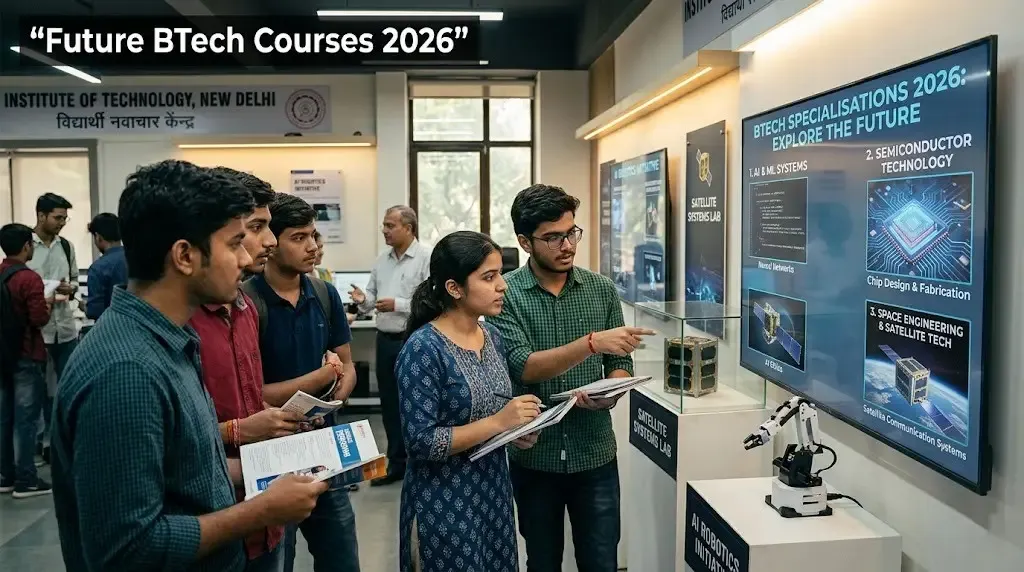
Engineering Colleges Launch Industry-Focused BTech Programmes for 2026 Admissions
Engineering colleges and universities across India are introducing new BTech specialisations focused on Artificial Intelligence (AI), Semiconductor Technology, VLSI Design, Aerospace Engineering, Robotics, and Space Technology for the 2026 admission cycle.
The expansion comes as industries increasingly seek engineers with expertise in advanced technologies linked to chip manufacturing, automation, artificial intelligence, satellite systems, and deep-tech innovation.
Education experts believe these emerging branches are being designed to align engineering education with future industry requirements and government technology initiatives.
Popular New BTech Specialisations for 2026
| Specialisation | Main Focus Area |
|---|---|
| Artificial Intelligence & Machine Learning | Intelligent systems and automation |
| Semiconductor Technology | Chip manufacturing and electronics |
| VLSI Design | Integrated circuit and chip design |
| Aerospace Engineering | Aircraft and space systems |
| Space Technology | Satellite and space research applications |
| Robotics & Automation | Smart machines and industrial automation |
Several institutions are also offering interdisciplinary programmes that combine AI with semiconductor technology, electronics, robotics, and advanced computing.
Why These Courses Are Growing Rapidly
| Growth Driver | Impact |
|---|---|
| AI Industry Expansion | Higher demand for AI engineers |
| Semiconductor Mission | Need for chip design specialists |
| Space Sector Growth | New opportunities in aerospace industries |
| Automation Adoption | Demand for robotics professionals |
| Deep-Tech Investments | Emerging high-skill engineering jobs |
India’s increasing focus on semiconductor manufacturing, AI innovation and private-sector participation in space technology is influencing curriculum changes across engineering institutions.
Universities Expanding Advanced Engineering Programmes
Several engineering institutions have announced new technology-focused programmes and specialised engineering tracks for the 2026–27 academic session.
| Emerging Area | Career Scope |
|---|---|
| AI & Data Science | Machine learning and analytics |
| Semiconductor Engineering | Chip design and fabrication |
| Quantum Technologies | Research and advanced computing |
| Aerospace & Space Systems | Defence and satellite industries |
| Cybersecurity | Digital security and infrastructure |
Institutions are increasingly partnering with technology companies to provide industry-aligned coursework, internships and project-based learning opportunities.
Eligibility for Most New BTech Programmes
| Requirement | Eligibility |
|---|---|
| Educational Qualification | Class 12 with Physics and Mathematics |
| Additional Subject | Chemistry / Computer Science / Biotechnology |
| Admission Route | JEE Main, State Exams, University Tests |
| Course Duration | 4 Years |
Admission procedures vary across universities and may include entrance examinations, counselling processes, and institute-level selection criteria.
Industry Experts Highlight Semiconductor Demand
Experts say semiconductor engineering and VLSI-related fields are attracting attention because global demand for chip manufacturing, electronics design and AI hardware continues to rise.
Universities are increasingly introducing specialised programmes focused on semiconductor systems, embedded technologies and integrated circuit design.
Space Technology Courses Attracting Student Interest
Interest in aerospace and space-related engineering programmes is also increasing as India's space ecosystem expands through research, satellite launches, defence applications and private-sector participation.
Some institutions have announced new aerospace engineering programmes and international collaborations aimed at strengthening advanced engineering education.
Honestly, many students are exploring these new branches because they see them as future-focused alternatives to traditional engineering streams while still offering strong technology and research opportunities.
Experts Advise Students to Check Curriculum Carefully
Career counsellors advise students to review faculty expertise, laboratory facilities, internship opportunities, industry partnerships and placement records before selecting highly specialised engineering branches.
Students should also evaluate personal interests and long-term career goals instead of choosing courses solely because they are trending.
For now, AI, semiconductor technology, VLSI design and space technology are emerging among the fastest-growing BTech specialisations available for the 2026 admission season.

Written by
Palak PatelEducation writer Palak Patel covers the latest education news, board exam updates, results, and career opportunities.