Can I Change My College After the First Year? Rules Explained
Can I Change My College After the First Year? Rules Explained
Many students realize after joining a college that it may not be the right fit for their academic goals, location, finances or career plans. As a result, one of the most common questions is whether it is possible to transfer to another college after completing the first year.
The answer is yes in some cases, but the process depends on the university's regulations, the availability of seats, your academic performance and whether the destination institution accepts transfer admissions. Before making a decision, it is important to understand the rules and possible challenges.
When is a college transfer possible?
| Condition | Why It Matters |
|---|---|
| University Transfer Policy | The receiving university must allow transfers or migration. |
| Seat Availability | Admission is possible only if vacant seats exist. |
| Academic Performance | Many colleges require satisfactory grades and no major academic issues. |
| Equivalent Course | The curriculum should be similar for smooth credit transfer. |
| Required Documents | Migration certificate, transcripts and transfer certificate are commonly required. |
Understand the difference between migration and transfer
Students often use the terms migration and college transfer interchangeably, but they may have different meanings depending on the university. Migration generally refers to moving from one university to another, while a transfer may involve changing colleges within the same university system. The exact procedure varies across institutions.
Important documents you may need
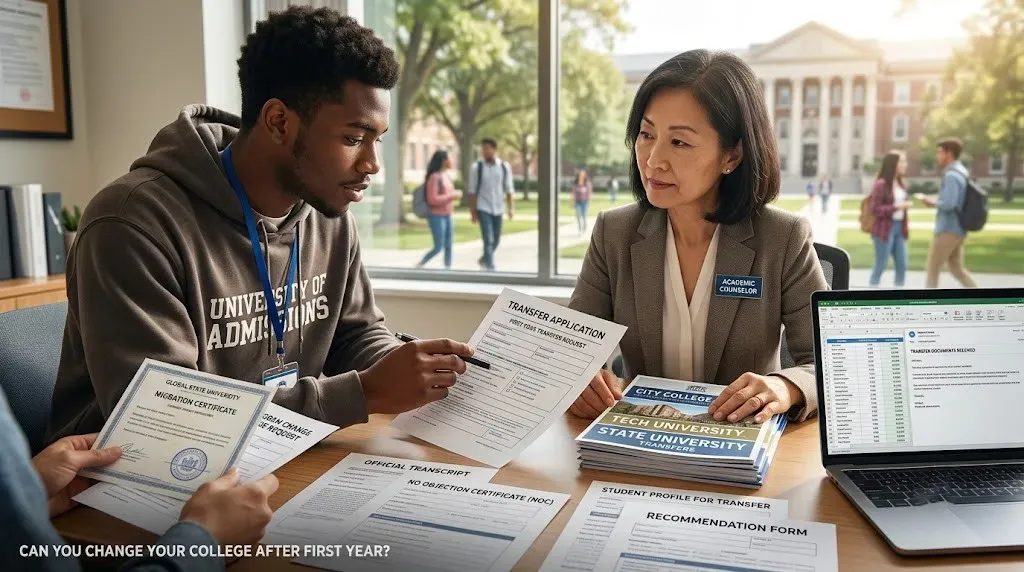
Although requirements differ, most institutions ask for documents such as academic transcripts, mark sheets, a migration or transfer certificate, a no-objection certificate if applicable, identity documents and proof of admission eligibility. Some universities may also require approval from both the current and receiving institutions.
Things to check before changing colleges
| Factor | Questions to Consider |
|---|---|
| Credit Transfer | Will your completed subjects be accepted? |
| Academic Calendar | Will you join without losing a semester? |
| Fee Structure | Are there additional admission or tuition costs? |
| Placement Opportunities | Does the new college better support your career goals? |
| Campus Environment | Will the new institution meet your academic and personal expectations? |
Is changing colleges always the best option?
Not necessarily. Before applying for a transfer, consider whether the challenges you are facing can be resolved without changing institutions. Issues such as adjusting to a new environment, improving study habits or participating in campus activities may improve your overall experience. However, if the college lacks academic quality, essential facilities or opportunities that align with your career plans, exploring a transfer may be a reasonable choice.
Frequently asked questions
Can I transfer to another university after the first year?
It is possible in some cases, but eligibility depends on the policies of both universities, seat availability and the similarity of the academic program.
Will all my credits transfer?
Not always. The receiving institution evaluates your completed courses and decides which credits can be accepted based on its curriculum.
Does changing colleges affect placements?
It can, depending on the placement opportunities, industry connections and academic reputation of the new institution. Compare these factors carefully before making a decision.
Changing colleges after the first year is possible for many students, but it requires careful planning and a clear understanding of university rules. Instead of making a decision based only on short-term disappointment, evaluate academic quality, transfer policies, career opportunities and your long-term goals. A well-informed choice can help you continue your education with greater confidence and better prospects for the future.

Written by
Palak PatelEducation writer Palak Patel covers the latest education news, board exam updates, results, and career opportunities.